


Google Ads' new Terms of Service: what you are agreeing to on 1 July 2026
Lotfi Zazoun
Business Operations
July 4, 2026
7 min read
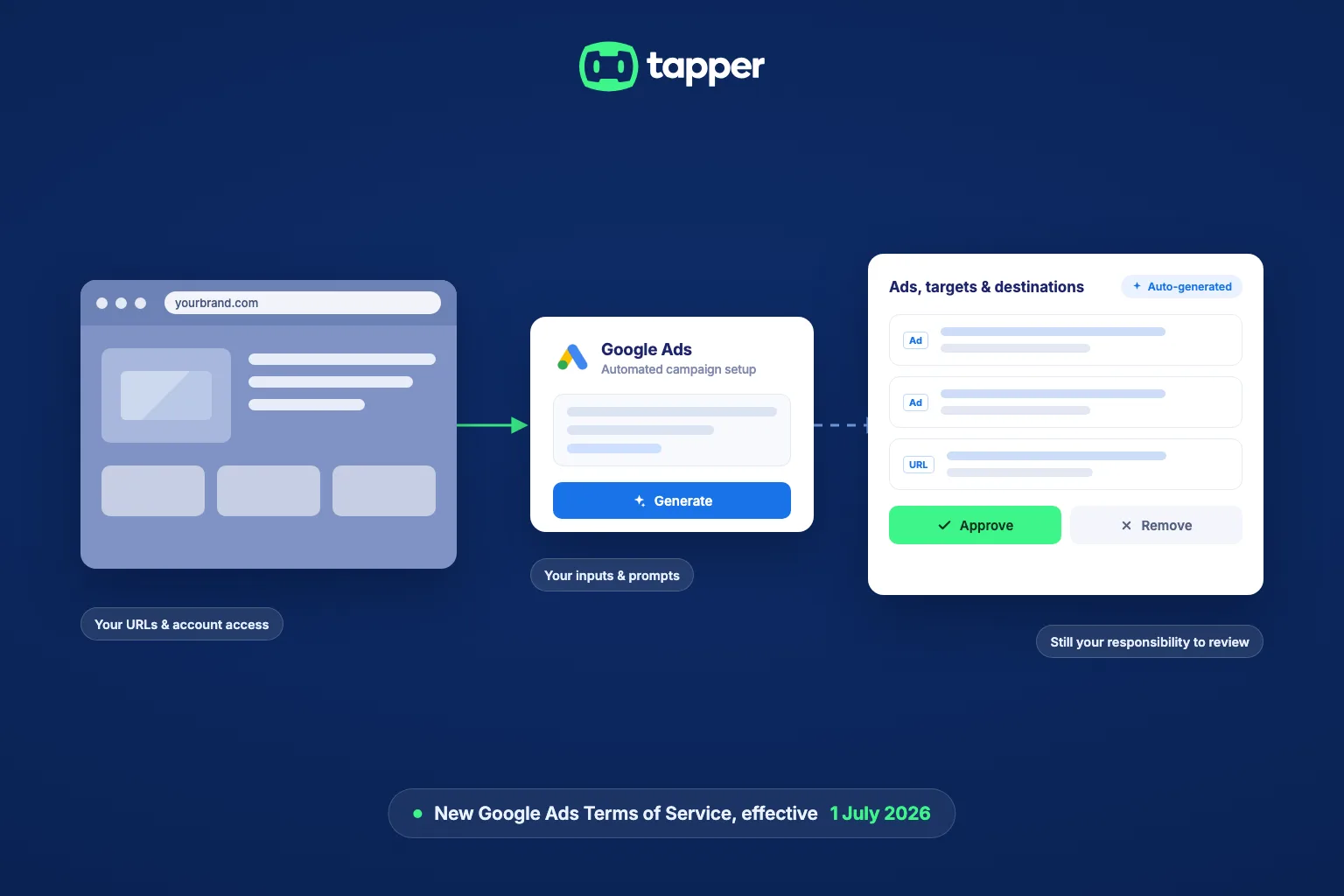
Google's updated Google Ads terms took effect on 1 July 2026 and required no action from advertisers. They also formalize Google's right to format, select, or generate your targets, ads, and destinations, while review, rights, and results stay yours. Here is what changed and what to audit now.
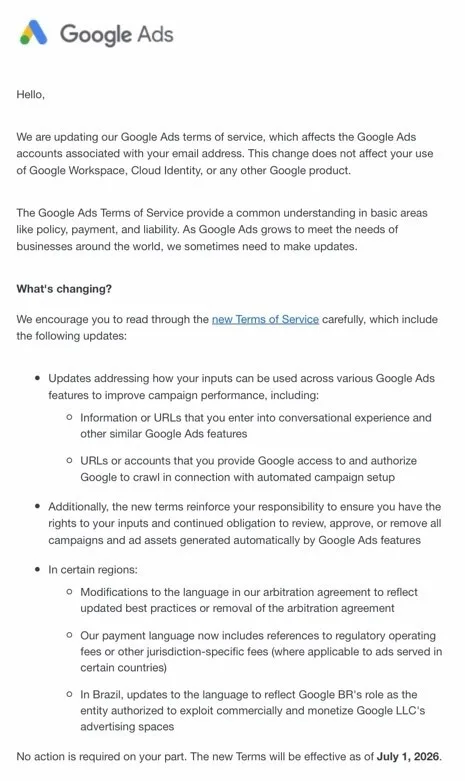
If you manage Google Ads accounts, an email has probably landed in your inbox in the last few weeks. It is polite, short, and ends with the most reassuring sentence in advertising: “No action is required on your part. The new Terms will be effective as of July 1, 2026.”
That sentence is technically true. It is also doing a lot of work.
Google has updated the Google Ads Terms of Service, and the update is mostly about one thing: formalizing, in the contract, how much of your account Google’s automated systems are allowed to build on your behalf. Nothing broke on 1 July. No campaigns paused. But the document that governs who decides what your ads say, who they target, and where they send people is being rewritten in favor of automation, while the responsibility for the outcome stays exactly where it has always been, with you.
Here is what actually changed, and what we would audit now.
What Google says is changing
According to the notice Google sent to advertisers, the updated terms cover:
- Broader language on how the inputs you provide can be used across Google Ads features to improve campaign performance, explicitly including information or URLs you type into conversational experiences and similar features.
- The URLs and account access you authorize Google to crawl in connection with automated campaign setup.
- A reinforced obligation that you hold the rights to your inputs, and that you review, approve, edit, or remove campaigns and ad assets that Google’s features generate automatically.
- Region-specific changes: modifications to (or removal of) the arbitration agreement in certain regions, new references to regulatory operating fees and other jurisdiction-specific charges, and updated language in Brazil confirming Google BR as the entity authorized to commercially monetize Google LLC’s advertising space.
Search Engine Land, reviewing the revised document, highlights the clause that matters most: the customer authorizes Google and its affiliates to serve ads “including through the use of automated program features to format, select, or generate targets, ads, or destinations on Customer’s behalf.”
Read that list again: targets, ads, or destinations. Who you reach, what they see, and where they land. Those are the three levers of a paid media program, and all three now sit inside a sentence that describes them as things Google may generate for you.
Why “no action required” is not the same as “nothing changes”
“No action required” means you do not have to click accept. It does not mean the operating model of your account is unchanged.
For the last two years, the direction of travel has been obvious to anyone running spend: Performance Max choosing placements, automatically created assets writing headlines, broad match plus smart bidding deciding intent, and now conversational setup flows that read your website and build a campaign from it. Each of those arrived as a product. The terms update is the paperwork catching up, and the contract now describes a world where generation is the default behavior rather than a feature you switched on.
The asymmetry is the part worth sitting with. Google is broadening what its systems may generate. The same document reminds you that reviewing, approving, and removing that output remains your obligation, and that you carry the rights liability for every input and asset. Authority moves one way. Accountability does not move at all.
The practical consequence: your account gets harder to audit from the inside
When you wrote the ad, picked the keyword, and chose the landing page, platform reporting was a reasonable mirror of your intent. You could compare what you asked for with what you got.
When the platform formats, selects, and generates on your behalf, that mirror gets fogged. The system reports on decisions it made, using data it collected, against conversions it attributed. If a generated destination pulls the wrong page, if an auto-selected placement is a low-quality app inventory slot, if a broadened target starts buying clicks that never behave like customers, the first place you will see it is not the platform’s own dashboard. Performance will simply look a little worse, in a way that is easy to explain away as seasonality or competition.
This is the same failure pattern we see constantly with invalid traffic. The money is not lost in one dramatic event. It leaks through a channel nobody is independently measuring.
So the honest read of the 1 July update is not “Google is taking over your account.” It is: the share of your spend that is allocated by decisions you did not make is going up, and therefore the value of independent verification goes up with it.
What to audit now that the terms are live
None of this requires panic, and none of it requires you to reject automation, because automated campaign types work, and for many accounts they outperform manual builds. It requires knowing what is generated, and keeping a record that is not produced by the same system doing the generating.
1. Inventory your automated surfaces. List, per account, which features are currently allowed to generate: Performance Max, automatically created assets, auto-applied recommendations, broad match expansion, AI-assisted and conversational campaign setup. Most teams find at least one enabled that nobody remembers switching on.
2. Decide who signs off on generated assets. The terms make review your obligation. An obligation with no owner and no cadence is not a control. Put a name against it and a weekly slot in the calendar.
3. Check your destinations. If Google may generate destinations, then every URL it can reach is effectively in scope. Crawl your own site the way an automated system would: expired promos, out-of-stock categories, thin location pages, legacy landing pages nobody has opened in a year. Remove or noindex what you would not pay to send traffic to.
4. Tighten your exclusions. Brand safety lists, negative keywords, placement and app exclusions, and geographic limits are the instructions that survive automation. They are the part of the account that still expresses your judgment, so they deserve more attention than they usually get, not less.
5. Keep click-level records outside the platform. If you cannot see the traffic yourself, every click, its source, its behavior on your site, and whether it ever looked like a real customer, then you are auditing automation with the automation’s own homework. Independent click and conversion records are what let you say “this generated asset is buying junk” with evidence instead of a hunch.
6. Brief legal and finance on the regional clauses. The arbitration changes and the regulatory operating fee references are not marketing items. If you run accounts across multiple jurisdictions, and especially if you bill through entities in Brazil or in regions where arbitration language changed, forward the notice to the people whose job it is to read it.
7. Set a baseline now. Record CPA, conversion rate, traffic quality, and share of spend by campaign type for June 2026, the last full month before the terms took effect. If something drifts in Q3, you will want a clean before-and-after rather than an argument about memory.
Where Tapper fits
Our whole position on automation is that it works best when it is fed clean signals and measured independently. Tapper sits beside your Google Ads account and keeps its own record of the traffic you actually paid for: every click, its fingerprint, its behavior, and whether it converted for real. It blocks the invalid traffic before it pollutes your bidding data, and it gives you ground-truth numbers to compare against platform reporting.
That was useful when you were choosing the targets yourself. When the platform is generating targets, ads, and destinations on your behalf, it becomes the only way to check the work.
Key takeaway
The new Google Ads Terms of Service took effect on 1 July 2026, and no advertiser action was needed for them to apply. What they formalize is that Google’s automated features may format, select, and generate your targets, ads, and destinations, while review, rights, and results stay your responsibility.
Automation is not the risk. Unverified automation is. Use the next few weeks to inventory what is generated in your accounts, name an owner for review, and make sure you hold a record of your traffic that Google did not produce.
Tapper is the intelligence layer that scores customer value potential and turns it into smarter campaign optimization across Google, Meta and TikTok
Run a pilot on your own account to set your baseline CPA, block invalid traffic in real time, and receive a final report comparing your CPA before and after protection.
Get a demo