

How Google's June 2026 Update Could Quietly Break Your Ad Tracking
Lotfi Zazoun
Business Operations
May 20, 2026
9 min read
On 15 June 2026, Google Ads stops letting GA4's Google Signals setting override its behavior and starts following the consent signals sent directly from your site. Here is what marketing leaders should audit before the change quietly distorts reporting, audiences, and ROAS.
If you have spent the last few years dealing with GA4 and Google Ads integrations, you already know tracking has not always been straightforward.
Until now, most businesses have relied on two layers of control. The first is the user's choice on the cookie banner through Consent Mode. The second is the Google Signals setting inside GA4, which has acted as a broader control over how user data is associated with Google services.
On 15 June 2026, that setup changes.
Google is removing the ability for Analytics settings to override Google Ads behavior. This is part of Google's move toward destination-specific controls. For some businesses, this will simplify measurement. For others, it removes a backstop they may not realize they are relying on.
At Tapper, we work on tracking and measurement infrastructure every day. Here is what marketing leaders need to understand before the June 2026 change affects Google Ads data.
Download the June 2026 consent briefing
A concise, shareable briefing on what changes on 15 June 2026 and the exact checks to run before it goes live. Built for both marketing and analytics teams.
Download the briefingWhat is changing in Google Ads
From 15 June 2026, Google Ads will rely more directly on the consent signals sent from your website.
Today, if you want to stop Google Ads from linking a website visitor to their personal Google account, you can turn Google Signals off in your GA4 property. That setting acts as an extra layer of control. Even if the website's tracking setup is not perfect, the GA4 setting can still help limit how data flows into Google Ads.
That will no longer work in the same way after the update.
From 15 June 2026, Google Ads will stop using the GA4 Google Signals setting as an override. Instead, it will follow the consent signals coming directly from your website code.
If your consent banner tells Google that consent has been granted, Google Ads will treat that as permission to use the data. That can include linking activity with signed-in Google profiles, building audiences, and using those signals for ad measurement and optimization.
This makes the consent banner much more important. It becomes the main control point for how Google Ads receives and uses tracking data.
Why this matters for marketing teams
The main risk is silent data loss.
If your consent banner is not configured correctly, your Google Ads reporting, audience building, and ROAS measurement could be affected without a clear warning in your dashboards.
The issue may not appear as a visible error. Campaigns may continue running. Reports may still populate. Audiences may still exist. But the underlying signals feeding those systems could be incomplete, inconsistent, or incorrectly passed.
That creates a measurement problem and a performance problem.
Google Ads relies on tracking signals to understand what is working. If those signals are wrong, bidding algorithms receive poor-quality data. That can affect conversion reporting, audience quality, remarketing, attribution, and budget decisions.
For marketing leaders, this is no longer only a compliance or analytics issue. It directly affects paid media performance.
The single source of truth is now your website code
The biggest shift is that control is moving away from the GA4 dashboard and toward the website itself.
Until now, many businesses have used the Google Signals toggle in GA4 as a way to limit data sharing with Google Ads. It worked as a manual control. If there was uncertainty around consent implementation, the GA4 setting provided another layer of protection.
After 15 June 2026, Google Ads will listen much more directly to what the website sends.
That means your website code, consent banner, tag setup, and server-side tracking configuration need to be accurate. The dashboard setting will no longer provide the same safety net.
If the website says consent is granted, Google Ads will act on that signal. If the website says consent is denied, Google Ads will have limited visibility.
There is less room for vague implementation. The signal needs to be correct at the source.
Why the binary consent approach matters
The update creates a much more binary environment for Google Ads tracking.
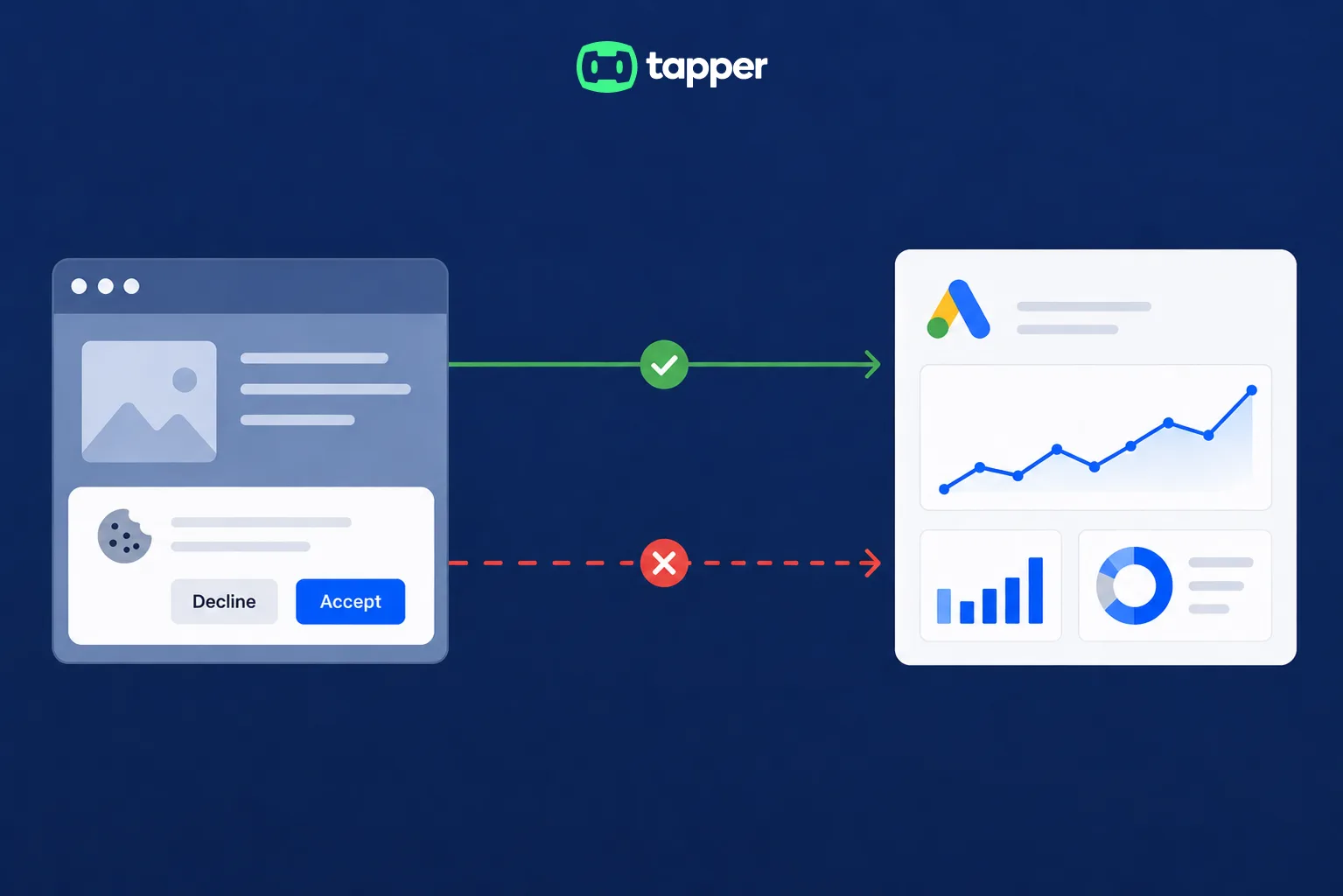
Each session will broadly fall into one of two states.
If consent is granted, Google Ads can use cookies, device IDs, and signed-in user profile linking where applicable.
If consent is denied, Google Ads is restricted. It may only receive limited information such as basic URL parameters and anonymous pings.
Until now, some businesses used the GA4 Google Signals setting to control the flow of data more broadly. That created a middle layer between the website and Google Ads.
From June 2026, that middle layer becomes much less relevant. The decision sits much closer to the user's consent choice and how that choice is passed through the website.
That makes technical accuracy critical.
If the banner fires the wrong signal, delays the signal, or fails to update consent status properly after a user accepts, Google Ads may receive incomplete or incorrect data.
The role of anonymous pings
For users who deny cookies, Advanced Consent Mode becomes more important.
When a user rejects cookies, a website can still send an anonymous ping to Google. This does not identify the user, but it gives Google limited information that can support conversion modeling.
This matters because attribution is already becoming harder. More users reject cookies. Browser restrictions continue to increase. Privacy rules are stricter. As a result, advertisers are relying more heavily on modeled conversions to understand performance.
For high-volume advertisers, these anonymous signals can become important for ROAS measurement.
But this only works if Advanced Consent Mode is configured correctly. If it is not, a denied user can become a much larger data gap.
That means the consent setup needs to be tested properly. It is not enough for the banner to appear on the website. The signals need to reach Google correctly in both accepted and denied states.
The measurement audit marketing teams need now
The priority is moving from dashboard management to signal accuracy.
To prepare for the June 2026 change, marketing teams should run three checks.
1. GCD audit
The first step is to audit the consent signals inside your tracking hits.
This means checking the gcd parameter, which helps show how consent status is being passed to Google.
The audit should confirm that the transition from denied to granted happens correctly when a user accepts cookies. It should also confirm that the signal updates quickly enough and is not delayed until after key tracking events have already fired.
This is important because timing matters. If a conversion or page event fires before the correct consent state is passed, Google may receive the wrong signal.
2. Privacy disclosure review
The second step is to review your privacy policy and consent wording.
Because more responsibility now sits with the consent banner, your privacy policy needs to clearly explain how data may be associated with Google signed-in user information.
This is not only a legal detail. It affects whether the consent experience is clear enough for users and whether the data collection setup matches what users have been told.
Marketing, analytics, legal, and privacy teams should review this together. The banner, privacy policy, and actual tracking behavior need to align.
3. Server-side verification
The third step is to check server-side tracking.
For businesses using server-side tagging, the server must pass consent signals correctly to Google. If consent strings are stripped, changed, delayed, or not forwarded properly, Google Ads may not receive the correct state.
This can create a false sense of confidence. The browser setup may look correct, but the server-side layer may still break the signal before it reaches Google.
Server-side verification should confirm that consent signals are preserved from the website through to the final Google destination.
How this could affect Google Ads performance data
This update is likely to change some of the numbers marketers see in Google Ads.
Even with a compliant and technically correct cookie banner, users can still decline cookies. When that happens, Google Ads has less data to work with.
The difference from June 2026 is that GA4 will no longer provide the same fallback control. Google Ads will rely on the consent signals it receives from the website.
That means gaps in consent implementation can directly affect reporting and optimization.
You may see changes in conversion volume, audience size, remarketing performance, attribution, and ROAS reporting. Some of these changes may come from real user consent choices. Others may come from incorrect implementation.
The only way to separate the two is to audit the setup before the change goes live.
Why the cookie banner is now part of media performance
The cookie banner can no longer be treated as a compliance box that sits outside the marketing strategy.
Its design, wording, placement, and technical behavior now have a direct impact on measurement quality.
If the banner is unclear, users are less likely to accept. If it is technically incorrect, Google may receive the wrong consent state. If it is not aligned with the privacy policy, the business creates risk.
This makes the cookie banner part of the paid media infrastructure.
Marketing teams need to work with analytics, legal, privacy, and development teams to make sure the banner is doing three things properly:
- It must clearly explain the user's choice.
- It must send the correct consent signals.
- It must update those signals accurately when the user makes a decision.
If any of those areas fail, Google Ads performance measurement can suffer.
Key takeaway
Google's June 2026 update makes your website code the final authority for Google Ads tracking.
The GA4 dashboard will no longer provide the same manual override through Google Signals. Google Ads will rely more directly on the consent signals sent from your website.
That means the accuracy of your cookie banner, tracking setup, and server-side configuration will directly affect reporting, audience building, and ROAS measurement.
The manual override is ending. Marketing teams need to make sure their consent signals are correct before 15 June 2026.
Download the June 2026 consent briefing
A concise, shareable briefing on what changes on 15 June 2026 and the exact checks to run before it goes live. Built for both marketing and analytics teams.
Download the briefingTapper is the intelligence layer that scores customer value potential and turns it into smarter campaign optimization across Google, Meta and TikTok
Run a pilot on your own account to set your baseline CPA, block invalid traffic in real time, and receive a final report comparing your CPA before and after protection.
Get a demo